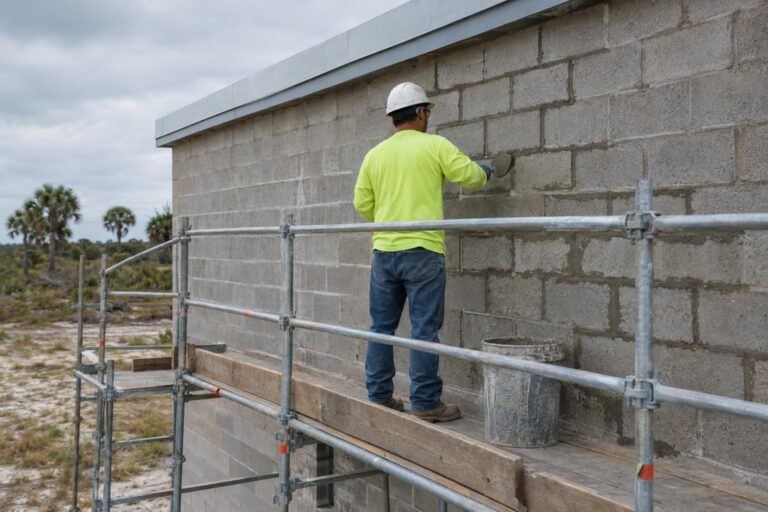
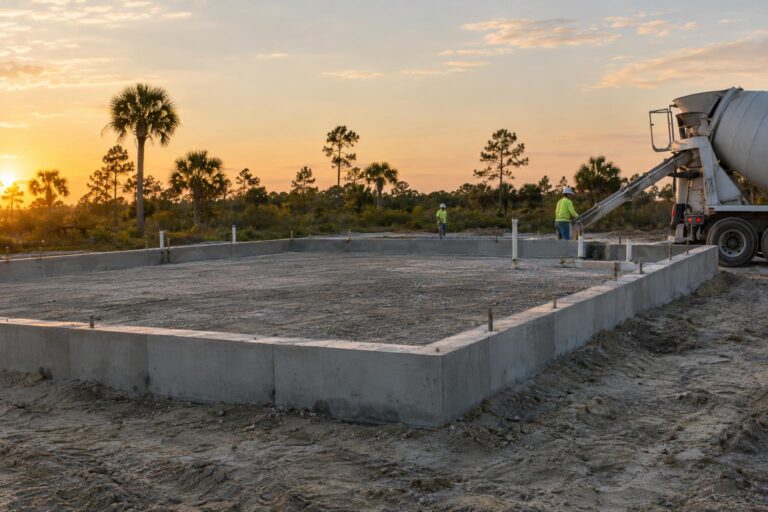
On a concrete placement day, a technician often stands beside the truck filling small plastic or steel molds. Those molds make the test specimens that become the paper record of what was delivered. Concrete cylinder testing is how a project checks that the strength it asked for in the design is the strength it actually got. This article follows a cylinder from the truck to the lab and explains what the results can and cannot tell you.
The testing agency, not the concrete contractor, usually performs and reports these tests. The project specifications set the schedule, the strength requirement, and the acceptance rules.
Why concrete cylinder testing is part of quality control
Structural designers choose a specified compressive strength for each element, such as footings, columns, slabs, or beams. Every other decision, including bar sizes and member dimensions, rests on that number. If the concrete delivered is weaker than assumed, the margin built into the design shrinks.
You cannot judge strength by looking at wet or even hardened concrete. Two mixes can look identical and perform very differently. Testing gives a measurement that can be compared with the specification.
It also creates a record. Test reports tie a set of cylinders to a date, a truck ticket, a location in the structure, and the fresh-concrete measurements taken at the time. If a question comes up later, the engineer and owner have something to review.
Cylinder results are one part of a larger quality program. They sit beside reinforcement inspections, mix submittals, and placement checks. For the steel and formwork side of that program, our article on reinforced concrete pre-pour review covers what is looked at before concrete is placed.
How cylinders are made on site
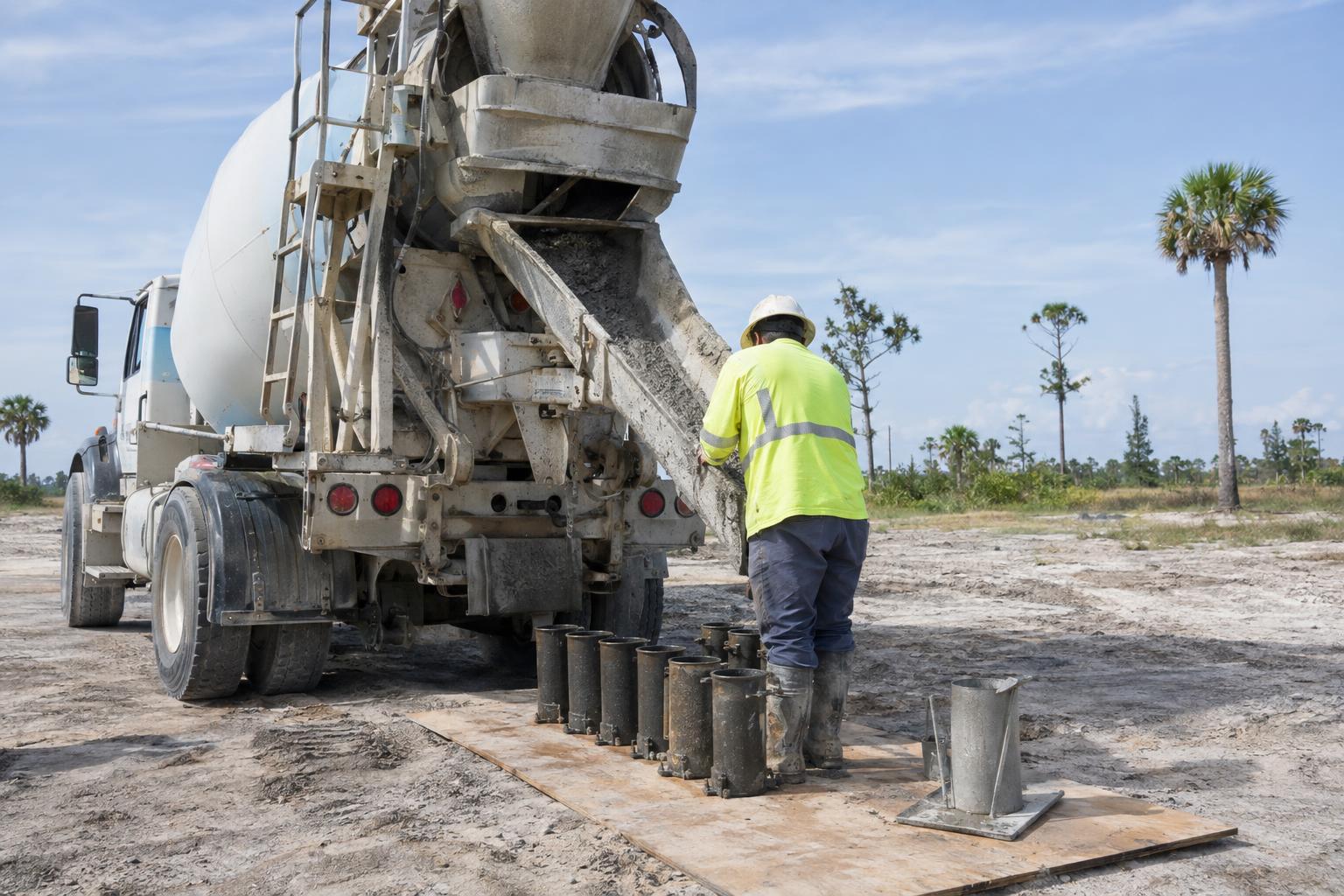
The process starts with a sample. A technician pulls concrete from the middle of the load, not the first or last bit out of the chute, so the sample represents the batch. Then come the fresh tests that tell the crew if the load is acceptable to place.
- Slump. Concrete is placed in a cone mold about 12 inches tall, the cone is lifted, and the amount the pile settles is measured. It is a quick check of consistency.
- Air content and temperature. These are measured with simple devices to compare with the specification.
- Cylinder casting. Specimens are filled in layers and rodded or consolidated to remove air pockets, then the top is struck off smooth.
The most common cylinder sizes are 6 inches in diameter by 12 inches tall and 4 inches by 8 inches. The specification or the testing agency decides which is used, and how many are cast per set. A set usually includes extra cylinders so that early breaks and the acceptance break can both be done.
Labels deserve attention. Each cylinder is marked with the project, the date, the truck or batch, and the element being placed. A mix-up between two sets can make good concrete look bad on paper, so a clear system saves headaches later.
Good handling in the first day matters a great deal. Cylinders are kept in a protected place, shielded from vibration, wind, and temperature swings, and labeled clearly. They are moved to the lab within the time window the standards allow. Careless handling can lower a result without saying anything about the concrete in the structure.
What happens in the lab
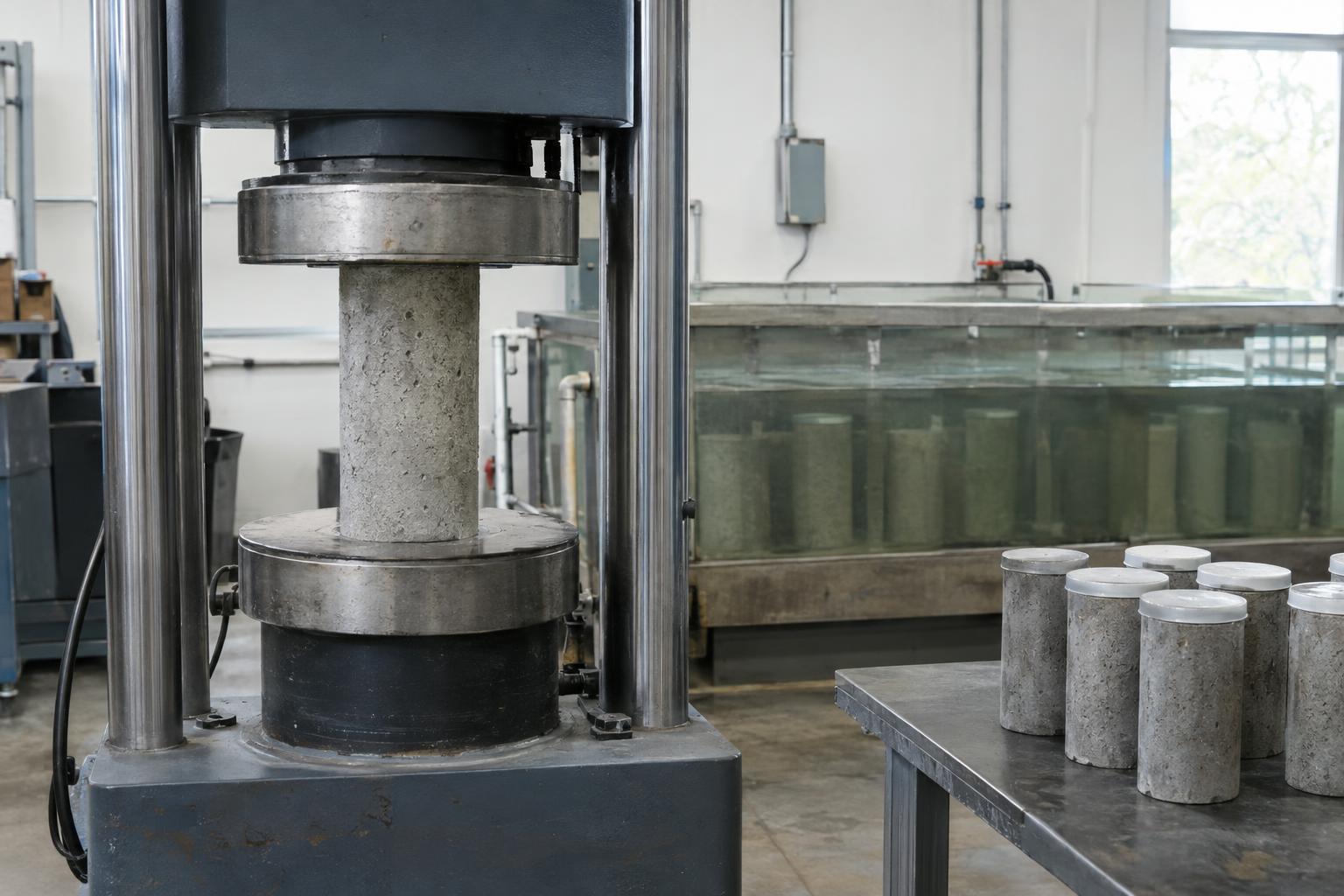
At the lab, cylinders are placed in a moisture-controlled curing environment, such as a water bath or a moist room. This standard curing is meant to give consistent conditions so that results can be compared across jobs and against the specification.
On the scheduled day, the technician measures the specimen, caps or prepares the ends so they are flat, and places it in a compression machine. The machine loads the cylinder at a controlled rate until it fails. The peak load is divided by the cross-sectional area to give strength in pounds per square inch.
The technician also notes the type of break. A clean, expected fracture pattern gives the lab more confidence in the number. An unusual break can point to a problem with the specimen, such as poor end preparation, rather than the mix.
The American Concrete Institute publishes the standards and educational material that many project specifications rely on, and its site is a good place to start if you want to read more about how strength is specified and evaluated.
Reading seven-day and 28-day results
Most projects schedule breaks at two or more ages. Seven-day breaks are an early look at how the mix is gaining strength. They help the team spot a trend, but they are not the acceptance test.
The 28-day break is the common age for acceptance. The project specification states the strength requirement and how test results are averaged and compared. A single low cylinder does not automatically mean the concrete failed, since the criteria usually look at the average of a set and at individual results against stated limits.
What if results come back low? The engineer of record decides what comes next. Options can include checking whether the specimen was handled correctly, reviewing records, taking other measurements, or evaluating the structure itself. Those decisions are technical and should be made in writing by the responsible professional.
Timing the reports helps the whole team. Early results let the contractor and engineer plan around formwork removal, loading, and the next placement. Late or missing reports slow all of that down, so it pays to agree on how and when results will be sent before the first pour.
Weather plays a role too. Hot Florida days can speed up early strength gain and shorten working time, while cooler or very wet conditions slow things down. Reports from the lab should be read alongside the placement-day weather and any delays at the site.
Field curing of the actual structure is a separate topic. Cylinders cured in a lab measure the potential of the mix. They do not describe how the finished slab or column was cured. Our concrete curing guide for Florida projects explains how curing on the structure itself is handled.
What to ask about testing on your project
You do not need a materials background to follow the testing on your project. A few questions keep the process clear.
Ask who hired the testing agency and who receives the reports. Ask how many cylinders are cast per placement and when each set will be broken. Ask how the results will be shared with the contractor, the engineer, and the owner, and how quickly.
It is also worth asking where the cylinders were kept in the first day, and who is responsible for them. Handling gaps are a common reason for confusing results, and they are easy to prevent with a clear plan.
The National Ready Mixed Concrete Association offers research and engineering resources that explain how ready-mixed concrete is specified, delivered, and tested.
Southwest Structural Inc builds structural concrete and masonry for residential and commercial projects. The project’s testing agency performs the testing on placement days, and that independent lab reports the results to the project team. You can read more about our approach on our structural concrete page.
Frequently asked questions about concrete cylinder testing
Why are cylinders broken at 28 days?
The 28-day age is the long-standing standard point for judging strength against the specification. Earlier breaks give a preview, and the project documents state which age governs.
Does the contractor test the concrete?
Usually not. An independent testing agency typically casts, cures, and breaks the cylinders and sends reports to the project team, as the specifications require.
What do the numbers on a report mean?
They show the strength reached by each specimen in pounds per square inch, along with details such as the date, the location in the structure, and the fresh-concrete test results.
Can one bad cylinder mean the concrete is bad?
Not necessarily. Handling or testing problems can affect a single specimen. The engineer reviews the full set of results and the acceptance criteria before drawing a conclusion.
Share your plan set through our commercial estimating page and ask for a walk-through of the placement plan, including how the testing agency’s sampling lines up with the pour schedule.